Destination guide
Muscat
Oman · Middle East
A verified $29.49/day Gulf floor, a free 14-day visa since 3 Aug 2026 — and an October that is 34.5°C, not autumn.
Prices verified 2026-10-01
Plan it with verified data
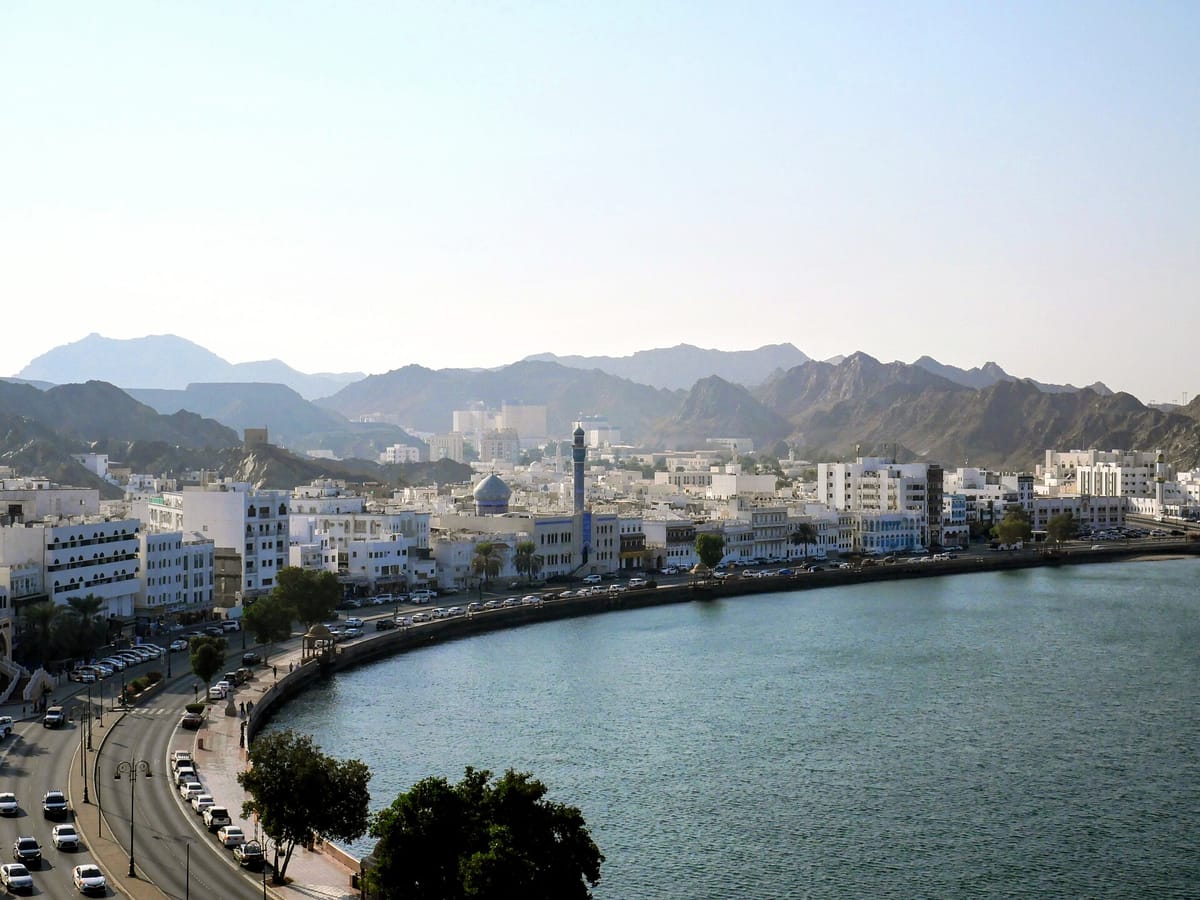
Muscat is the Gulf’s budget outlier, and the reason is not marketing. A verified floor of $29.49/day excluding rent, $1.30 bus tickets, $0.62/litre petrol, and a visa that became free on 3 August 2026 stack up against a country where, in the first half of 2026, hotel occupancy fell nearly 15% while arrivals held flat. That combination — cheap fundamentals, softening hotel demand, and a free entry window — is the actual case for October 2026.
Two things this guide refuses to do: call October autumn, and quote a visa price it cannot source.
For the monthly-cost breakdown, the stack trace, and the 14-day visa ceiling maths, see the Muscat cost post.
The cost floor
Numbeo’s Muscat page, stamped 25 September 2026 and built from 729 entries by 60 contributors, puts a single person at $884.7/month excluding rent — $29.49/day — and a family of four at $3,088.6. Against a local average net salary of $1,671.32 that is a genuinely livable ratio, and the city is 50.8% less expensive than New York excluding rent with rent 85.0% lower.
Worth saying plainly, because most competitor guides get this wrong: the comparison city is New York. Numbeo publishes no Los Angeles row for Muscat. If you have read “Muscat is X% cheaper than Los Angeles” elsewhere, that line was pattern-matched from another country.
The country-level page is the cross-check and it lands in the same place: Oman as a whole is 34.3% below the United States excluding rent, with rent 67.3% lower, on 964 entries by 91 contributors.
What actually costs money
The daily floor hides two bills that surprise Gulf newcomers, and both are the same story — Oman prices transport and fuel like a middle-income country and utilities and connectivity like a developed one:
| Line | Verified | Note |
|---|---|---|
| Inexpensive restaurant meal | $5.20 | range $2.60–13.00 |
| Mid-range 3-course, two people | $39.01 | range $20.81–104.03 |
| McDonald’s combo | $7.80 | |
| Domestic draft (1 pint) | $13.00 | #1 most expensive in the world, 529 cities |
| Cappuccino | $5.07 | |
| Bus, one way | $1.30 | |
| Bus, monthly pass | $78.02 | |
| Taxi start / per mile | $3.25 / $4.19 | $7.80 per hour waiting |
| Gasoline, per litre | $0.62 | per litre — no gallon row exists |
| Broadband, unlimited 60Mbps+ | $70.55/mo | range $65.02–109.23 |
| Basic utilities, 915 sq ft | $178.95/mo | electricity, cooling, water, garbage |
| Mobile, 10GB+ | $30.81/mo | |
| 1-bed rent, city centre | $680.89/mo | outside centre $453.12 |
Two of those deserve emphasis. Petrol at $0.62/litre is the single biggest reason a self-drive trip here is cheap — it is roughly a fifth of European pump prices. And broadband at $70.55/month is the line item that will wreck a nomad budget, sitting above the entire monthly bus pass and within touching distance of a quarter of a centre apartment’s rent. Budget for the internet before the apartment, not after.
Salalah has no published cost data — and that is a finding
October is 34.5°C, not autumn
This is the correction that matters most for an October guide. Two independent sources agree: climatestotravel (WMO 1991–2020 normals) gives Muscat October a mean of 29.4°C, highs of 34.5°C and 1 mm of rain; Open-Meteo’s ERA5 reanalysis for October 2025 gives a mean daily maximum of 34.4°C and 0.0 mm for the whole month. Two sources, 0.1°C apart.
The same climate source classes April through October as “the long summer, very hot”, with May and June peaking at 34–35°C means and heat records of 48.5°C. October is the cool edge of a very hot season — the good news is that the worst is over, the bad news is that “over” still means 34.5°C.
Salalah runs cooler and wetter as always: October mean 27.1°C, highs 31.1°C, 5 mm of rain. The khareef — the Dhofar monsoon that greens the escarpment and draws crowds to Salalah — is a June-to-September phenomenon, so an October visit arrives after the khareef wadis have dried. That is the honest version of the “shoulder season” claim: you are late for the green, and early for the cool.
If heat is your binding constraint, the answer is December to March, when Muscat’s January mean falls to 20.9°C. October is the compromise — the wadi and mountain season opening, the desert runs pleasant, and the heat manageable if you plan around the middle of the day.
The safety picture, in the order gov.uk states it
No advise-against zone, no “reconsider travel”, and no CAT alert anywhere on the Oman pages as published on 1 October 2026. The headline risk is regional, and the same advice names Oman in it directly: following the US–Iran memorandum of understanding on 17 June 2026, “since 8 July there have been strikes and retaliatory attacks by Iran in a number of locations across the region, including Oman” against US military and civilian infrastructure. The published mitigations are practical — expect flight cancellations and short-notice airspace closures, keep away from military and security facilities, and if advised to shelter, go inside a secure structure with as few external windows as possible, and never approach drone or missile debris.
Terrorism is the standing risk: attacks “cannot be ruled out”, may be “indiscriminate”, and the named target list includes residential compounds, restaurants, hotels, beaches, shopping centres and places of worship. The cited precedent is the July 2024 shooting near a mosque in Wadi Kabir, Muscat, which killed six.
The tourism number is flat, and the hotel number is the story
The single most repeated claim about Oman’s 2026 tourism is wrong, so here is the replacement.
NCSI figures reported on 1 August 2026: 1.8 million tourists arrived in H1 2026, flat against H1 2025 — the report says figures are “similar to those recorded during the same period of last year”, not that they are a record. ⚠️ The “highest on record” framing, which circulates widely, is not supported by the source. The top markets were UAE 491,000, India 382,000, Germany 68,000.
The real signal is inside the same NCSI data: while arrivals held flat, hotel occupancy fell nearly 15%, hotel revenue fell 12%, and guest numbers fell 13% in the first half. Occupancy is the pressure gauge on prices. Flights were part of the cause — thousands of cancellations and regional airspace closures — and the same report carries a World Travel & Tourism Council estimate that Middle East tourism could be losing up to $600 million a day to flight restrictions.
So: the demand that did arrive spent less time in hotels. For a traveller booking in October 2026 that is a favourable skew, and it is a much better argument than a boom that did not happen.
Getting around
Muscat’s public transport is the cheap skeleton — $1.30 a ticket, $78.02 a month. Outside the city, metered taxis at $3.25 start and $4.19 a mile are the sane answer, and at $0.62/litre the self-drive calculus is the strongest argument for a rental in this guide [inferred]. For the mountains, a car with a driver is the conventional choice; the 2026 traveller debate about whether Jebel Shams needs a 4x4 is genuinely unresolved, with recent reports of 2WD ascents alongside standing advice to use AWD — take a driver rather than betting the trip on forum consensus [inferred].
Muscat to Salalah is roughly a 10-hour drive, or a flight to the Dhofar gateway that turns the khareef-adjacent south into a viable second week [inferred].
Getting around in Salalah — with an honest blank
No Salalah cost dataset exists, so no Salalah transport, rent or food figures are published anywhere above. The country-level figures are the only honest proxy. That is a limitation of this guide, stated rather than filled in.
The visa is free, and the instrument is not what you think
Since 3 August 2026, Oman has a free 14-day tourist visa. The mechanics matter more than the headline:
- It is a Decision 109/2026 of the Royal Oman Police, amending Article 10 of the Executive Regulations of the Foreign Residency Law — not, as widely reported, a “Royal Decree 109/2026”. It sits under Royal Decree 16/95 and Decision 63/96.
- It was published in Official Gazette No. 1659 on 2 August 2026 and took force the following day.
- A new line in the Article 29 fee schedule formally creates it as a category free of charge — this is the primary-source basis for “free”, not a travel-blog inference.
- Holders may swap it before expiry for another tourist visa category, paying the prescribed fee for that category. That is the practical route to a longer stay.
- Eligibility is for nationals of countries “designated by the authority” — and the designation list is published, just not in the press release. The Foreign Ministry’s own Entry visas page spells out two groups: 78 named countries (UK, US, Canada, Australia, Japan, China, Indonesia, Philippines, Brazil, Malaysia, Thailand, Turkey, South Africa and the rest of Europe) with no extra condition, and 24 named countries (India, Egypt, Jordan, Morocco, Mexico, Vietnam, Tunisia, Kazakhstan) who must additionally hold residence in — or a valid entry visa for — the US, Canada, Australia, UK, Schengen or Japan, or a GCC residency. The Ministry of Heritage and Tourism puts the same exemption at “approximately 103 countries worldwide”, which reconciles exactly to 78 + 24. ⚠️ The two 14-day instruments have different rules and are easy to conflate: the visa-free facility cannot be extended or transferred to any residence visa, while the new 14-day tourist visa can be replaced before expiry with another tourist category at the prescribed fee.
For a full British citizen passport, gov.uk’s own position is simpler: up to 14 days without a visa, a visit visa available on arrival, passport valid 6 months past arrival, and at the border you must show a return ticket, accommodation proof and travel insurance. ⚠️ One gap we will not paper over: the entry page is completely silent on any chaperone or husband’s-permission requirement, in either direction. Silence is not a verified “not required” — if that matters to your trip, ask the Omani Embassy in London directly.
FAQ
How much does Oman cost per day?
The verified floor is $29.49/day — Numbeo’s $884.70/month for one person excluding rent (Muscat, 25 Sep 2026). Realistic traveller bands [inferred]: $55/day budget, $100/day mid-range, $200/day the resort-and-driver version. Add a 10% buffer, and remember that the two shocks are the $70.55/month broadband and $178.95/month utilities if you are on a monthly rental rather than a hostel.
Is October really a good time to go?
It is the start of the good season and the end of the punishing one — but it is hot, not autumn. Muscat October: mean 29.4°C, highs 34.5°C, 1 mm rain (WMO 1991–2020), independently matched by ERA5 reanalysis at 34.4°C and 0.0 mm. Salalah is milder at 27.1°C mean. You get the wadi and mountain season opening and the crowds gone, at the cost of genuine heat — and October falls inside the October-to-March flash-flood window for wadis.
Do I need a visa for Oman, and what does it cost?
For a full British citizen passport, no visa is needed for up to 14 days, and since 3 August 2026 the 14-day tourist visa is formally free of charge in Oman’s Gazette. A visit visa is also available on arrival. The only rial figures gov.uk publishes are the overstay penalties: up to OMR 10/day, maximum 500 rials (~$26/day, ~$1,300 cap). The instrument is Decision 109/2026 of the Royal Oman Police — often misreported as a Royal Decree.
Is Oman safe to visit right now?
By the published UK advice, yes, with a named regional caveat: no advise-against zone is in force anywhere in Oman, but the same page states that Iranian strikes since 8 July have affected locations across the region “including Oman” against US military and civilian infrastructure, so expect disruption to flights and airspace. The standing risks named are terrorism, which “cannot be ruled out” and may be indiscriminate at hotels, beaches and shopping centres, and the drug and alcohol laws, which are severe. This guide does not publish a US State Dept advisory level because that page returned an HTTP 403 when we tried to read it this cycle.
Can I work remotely from Muscat?
Partly, and the connectivity is honest rather than good. Broadband is $70.55/month and utilities run $178.95 for a standard apartment, so a nomad on a monthly lease carries a large fixed overhead before buying anything else. An Omantel eSIM runs $20.50 for 3 days up to $99.00 for 30. There is no digital-nomad visa programme published, and the 14-day visa can be swapped before expiry for a longer tourist category at the prescribed fee. Coworking space counts and prices for Muscat could not be verified this cycle and are deliberately left out.
Then the rules that catch people out, all from the same page:
- Alcohol is legal from 21, but liquor licences are not available to non-residents. With Muscat ranked the most expensive city in the world for domestic beer, treat drinking as something you do rarely or not at all.
- Sharing a hotel room with someone of the opposite sex is illegal unless married or closely related. This one reshapes who can travel cheaply together.
- Some UK medicines are illegal in Oman; carry a copy of any prescription.
- Foreign nationals must clear debts and fines before departure, and a blood test is administered on arrest.
And the one that is genuinely an October item: wadi flash flooding is a risk “from October to March”. Check the forecast, avoid wadis during heavy rain and for at least a day afterwards, and if caught in one, go to high ground and do not attempt to cross.
There is no Numbeo dataset for Salalah. The city is registered in Numbeo’s Oman dropdown, but /in/Salalah and /in/Salalah_2 both return “Cannot find city id” — and they do it while returning HTTP 200, so the error page is indistinguishable from a live page to a casual fetch. If you see a Salalah cost breakdown somewhere, ask where the number came from. The country-level Oman figures above are the nearest honest proxy and nothing more specific exists.
For solo female travelers
- Safetygov.uk publishes no advise-against zone anywhere in Oman, and rates sexual assault and personal attacks against foreign nationals as relatively rare — while still telling you to take care walking alone at night, using UK-level situational awareness. Two named realities that outrank the general advice: terrorism cannot be ruled out and attacks could be indiscriminate, with hotels, beaches, shopping centres and places of worship named as target types and the July 2024 Wadi Kabir mosque shooting in Muscat (6 killed) cited as the precedent [inferred].
- At nightThe single most useful thing for a solo female traveller is that it is illegal to share a hotel room with someone of the opposite sex unless married or closely related — a rule that protects a solo traveller rather than constrains one. Taxis are metered and priced by the mile ($4.19), the local bus is $1.30, and the wider Gulf's night-time harassment pattern is not what the 2026 traveller conversation describes here. Forum sentiment in 2026 is overwhelmingly reassuring on safety, with the live minority thread being cultural conservatism, not crime — and only gov.uk governs the claim [inferred].
- Dress & cultureModest dress is the practical rule: shoulders and knees covered for mosques and wadis, swimwear at the beach and pool. This is the friction point that shows up in solo-female 2026 threads — travellers who want a nightlife-heavy trip find the scene conservative, not dangerous. Alcohol is a non-residents' problem (see above), and gov.uk states plainly that cross-dressing is illegal [inferred].
- Where to stayThe verified number is the constraint: a 1-bed apartment in the Muscat centre is $680.89/month against an average net salary of $1,671.32, with a price/income ratio of 6.67 and a 5.41% gross centre yield — Muscat is the rare Gulf city where the rent-to-income maths is closer to Istanbul than to Dubai. Outside centre drops to $453.12, and a monthly transport pass at $78.02 is cheaper than most Gulf cities' rent for a week [inferred].
Connectivity & remote work
- SIM / eSIMAiralo carries an Oman local eSIM on Omantel: unlimited data at $20.50 for 3 days, $29.50 for 5, $36.50 for 7, $49.00 for 15, $99.00 for 30. Broader MENA regional from $6.50 and global from $8.50 are both cheaper per day if you are crossing borders. The local plans are pricey relative to the regional ones because unlimited-on-one-network is the expensive shape — take the 5-day local plus regional top-ups for a two-city trip rather than a 30-day local [inferred].
Sources & verification
Every price on this page was checked against these sources — last verified 2026-10-01.
- Numbeo Muscat cost of living, USD display — single person excl. rent $884.7/mo (OMR 340.2), family of four $3,088.6, 50.8% less expensive than New York excl. rent, rent 85.0% lower than New York, avg net monthly salary $1,671.32; 729 entries by 60 contributors past 12 months; page stamp 'Sep 2026', last update 25 September 2026; page states 'No sources and references provided yet' (self-submitted, treat as indicative)
- Numbeo Muscat cost of living — restaurants: inexpensive meal $5.20, mid-range 3-course for two $39.01, McDonald's combo $7.80, domestic draft (1 pint) $13.00, imported beer (12 oz) $13.00, cappuccino $5.07; Muscat ranked 1st of 529 cities for domestic beer price on the same page; transport: one-way ticket $1.30, monthly pass $78.02, taxi start $3.25, taxi 1 mile $4.19, taxi 1hr wait $7.80; gasoline PER LITRE $0.62 (no gallon row exists); utilities: basic utilities 915 sq ft $178.95, broadband unlimited 60Mbps+ $70.55/mo, mobile 10GB+ $30.81; rent 1-bed centre $680.89, outside centre $453.12, 3-bed centre $1,317.74; buy $/sq ft centre $263.90; all page stamp 25 September 2026
- Numbeo Muscat property prices (OMR display) — price/income 6.67, mortgage 53.97% of income, loan affordability 1.85, price/rent centre 18.50 and outside 16.36, gross rental yield centre 5.41% and outside 6.11%; 1-bed centre OMR 261.80/mo, outside OMR 174.22/mo, 3-bed centre OMR 506.67; avg monthly net salary OMR 642.62; 115 entries from 20 contributors over 18 months; last update 25 September 2026
- Numbeo Oman country cost of living (OMR display) — single person excl. rent $812.4, family of four $2,880.7, 34.3% lower than the United States excl. rent, rent 67.3% lower; 1-bed centre OMR 208.00, outside OMR 150.74; gasoline 0.24 OMR/litre, broadband 28.70 OMR/mo, mobile 12.36 OMR/mo, avg net monthly salary OMR 994.77; 964 entries by 91 contributors; last update 25 September 2026
- GOV.UK Oman entry requirements — up to 14 days without a visa on a full British citizen passport; overstay fines up to 10 Omani rials a day with a total maximum of 500 rials; visit visa available on arrival at an Omani airport or applied for online as the 'unsponsored visit visa' (NO visa fee is published on the page); passport expiry must be at least 6 months after arrival; border control requires return/onward ticket, proof of accommodation and travel health insurance; yellow fever certificate only if arriving from Rwanda, Tanzania or a listed transmission-risk country; Oman does not recognise dual nationality and one passport may be confiscated; the page is SILENT on any chaperone or husband's-permission requirement either way
- GOV.UK Oman travel advice, Warnings and insurance — still current 1 October 2026, updated 22 July 2026; US-Iran MOU 17 June 2026 and 'since 8 July there have been strikes and retaliatory attacks by Iran in a number of locations across the region, including Oman, against US military and civilian infrastructure'; possible flight cancellations, airspace closures, stay away from security/military facilities, shelter and drone/missile-debris guidance
- GOV.UK Oman safety and security — still current 1 October 2026, updated 22 July 2026; NO 'do not travel'/'reconsider travel' zone published for Oman and no CAT alert present on the pages as fetched; terrorism 'cannot be ruled out', attacks 'could be indiscriminate', named targets include residential compounds, restaurants, hotels, beaches, shopping centres and places of worship, with the July 2024 Wadi Kabir (Muscat) mosque shooting (6 killed) cited; alcohol legal age 21 and liquor licences NOT available to non-residents; illegal to share a hotel room with someone of the opposite sex unless married or closely related; severe drug penalties including the death penalty; drone licence required; blood test on arrest; cross-dressing illegal; foreign nationals must clear debts/fines before departure; wadis prone to flash flooding after heavy rainfall 'from October to March', avoid during and for at least one day after; tropical cyclones sometimes affect Oman July-August
- Oman Foreign Ministry, 'Entry visas' visitor page (fm.gov.om, page footer 'Last updated on September 22, 2026' on the sister consular page) — PUBLISHES the eligible-nationality lists in full: 'visitors from more than 100 countries and regions are exempt from entry visas for stays up to 14 days', split into two groups; Group 1 (78 named entries incl. UK, US, Canada, Australia, Japan, China incl. Hong Kong and Macau, Indonesia, Philippines, Brazil, Malaysia, Thailand, Turkey, South Africa) carry no extra condition; Group 2 (24 named entries incl. India, Egypt, Jordan, Morocco, Mexico, Vietnam, Tunisia, Kazakhstan) must ALSO 'be either residents or have a valid entry visa for one of the following countries (the United States of America, Canada, Australia, the United Kingdom, Schengen Agreement countries, Japan), or to be residents of' those/GCC; conditions are a passport valid 6+ months, a return ticket, a confirmed hotel reservation, health insurance, and funds to cover the stay; the 14-day stay 'cannot be extended or transferred to any type of residence visa'; spouse and children benefit even if not nationals of the country; GCC nationals (Bahrain, Kuwait, Qatar, Saudi Arabia, UAE) need no visa; ROP manages the process via evisa.rop.gov.om (note: bare evisa.gov.om does NOT resolve), eVisa call centre 80080011 in-country / +968 22848200 abroad
- Oman Ministry of Heritage and Tourism, Experience Oman visa page (experienceoman.om) — 'The Sultanate of Oman offers a visa exemption for transit to citizens of approximately 103 countries worldwide' and 'In most situations, a tourist visa CAN BE OBTAINED UPON ARRIVAL; nevertheless, it is PREFERABLE TO OBTAIN THE VISA PRIOR TO TRAVEL' — an official source for the ~103 figure, which the Foreign Ministry press release does not itself state
- Oman Foreign Ministry, 'Oman introduces free 14-day tourist visa' (3 August 2026) — new paragraph added to Article 10 of the Executive Regulations of the Foreign Residence Law creating a 14-day tourist visa granted to nationals of countries DESIGNATED BY THE AUTHORITY on request; a new entry in the Article 29 fee schedule formally introduces it as a category FREE OF CHARGE; holders may replace it before expiry with another tourist visa category subject to requirements and prescribed fees; issued by Lt. Gen. Hassan bin Mohsin Al Shuraiqi, Inspector General of Police and Customs, under Royal Decree 16/95 and Decision 63/96 with Ministry of Finance approval; published in Official Gazette No. 1659 on 2 August 2026, in force the following day. NOTE: this press release states the designation authority but does not itself publish the nationality list — that list IS published on the Foreign Ministry's 'Entry visas' visitor page (see above). The page also flags its English text as an UNOFFICIAL translation of an Arabic report
- decree.om index entry, 'Royal Oman Police: Decision 109/2026 Amending Some Provisions of the Executive Regulation of the Foreigners Residency Law' (2026/109, indexed 27 July 2026) — independently confirms the instrument is a ROP DECISION 109/2026, not a 'Royal Decree' 109/2026, and that it amends the Executive Regulation of the Foreigners Residency Law
- Oman Observer, 'Oman receives 1.8m tourists in the first half of 2026' (published 1 Aug 2026, citing NCSI) — 1.8 million tourists arrived in H1 2026, 'maintaining figures similar to those recorded during the same period of last year'; top markets UAE 491,000, India 382,000, Germany 68,000; Omanis travelling abroad down to 2.8m from 2.9m; NCSI indicators show hotel occupancy down nearly 15%, hotel revenue down 12% and guests down 13% in H1, while Q1 accommodation and food services added value grew 1.2% to about RO 194 million from RO 192 million in Q1 2025; Eleventh Five-Year Plan targets 5.6% tourism growth by end-2026; WTTC estimate carried in the same piece that Middle East tourism could lose up to USD 600 million daily from flight restrictions and cancellations. The 'highest on record' and 'May +67% YoY India' claims in the scout brief are NOT supported by this source and are not published
- climatestotravel.com Muscat (WMO 1991-2020 normals) — October min 24.4 / mean 29.4 / max 34.5 °C, 1 mm rain over 0 days, 10 hours daily sunshine; annual rainfall 90 mm; tropical desert climate; the page explicitly classes 'Summer, from April to October' as very hot with May-June the hottest at 34-35 °C mean and heat records of 48.5 °C; winter is December-February with a January mean of 20.9 °C
- climatestotravel.com Salalah (WMO 1991-2020 normals) — October min 23.1 / mean 27.1 / max 31.1 °C, 5 mm rain; annual rainfall about 100 mm concentrated in summer; khareef is the June-September summer monsoon affecting Dhofar, with July-August maxima of 22 and 25 mm and September 10 mm; sea temperature 27.7 °C in October
- Airalo Oman eSIM (airalo.com) — primary network Omantel; local unlimited data 3 days $20.50, 5 days $29.50, 7 days $36.50, 15 days $49.00, 30 days $99.00; Middle East and North Africa regional eSIMs from $6.50, Global from $8.50; page carries a 2026 copyright and no publication date
- open.er-api.com OMR feed (provider exchangerate-api.com), timestamp Thu, 01 Oct 2026 00:02:31 UTC — 1 OMR = 2.600801 USD, 1 USD = 0.384505 OMR. Cross-check: Numbeo's own USD and OMR columns imply 884.7/340.2 = 2.60053 OMR/USD, agreement within 0.01%
- [inferred] traveller daily bands above the verified Numbeo floor, hostel/hotel/resort ranges, the street-food anchor, intercity and local transport anchors, the Muscat-Salalah shape, the 10% budget buffer rationale, emergency and embassy numbers, and the seasonality multiplier; the US State Dept Oman advisory level (travel.state.gov returned HTTP 403), the Muscat/Salalah coworking count and price floor (coworker.com 302 redirect loop), the pre-decree OMR 5 visit-visa price, the eligible-nationality list for the free 14-day visa, and ANY Salalah cost-of-living figure (Numbeo has no Salalah dataset, verified soft-404) were each NOT verifiable this cycle and are deliberately unquoted
Planning this trip?
Run Muscat through the Trip Cost Calculator — destination, length, and travel style in, a real day-rate out.
Open the Trip Cost CalculatorFollow the receipts
New verified costs land in the feed as they're checked — subscribe in your reader, no email required.